
New Year's Message

January 1, 2008
Dear Buyū:
Happy New Year! It feels as if 2008 will be a year of great import. Be vigilant—not just of the potential dangers, but also for the opportunities! As Hatsumi Sensei said, the year of nezumi(鼠) is a fitting year for a Ninja.
As in other years, I had the privilege of training with many Buyū from around the world. I visited Italy, Texas, California, Florida, and Chicagoland some more than once. Pedro Fleitas and I attended the South American TaiKai in Argentina. Over 260 Buyū from 11 countries joined together to train in a great atmosphere hosted by Christian Petrochello and Nestor Iscovi.
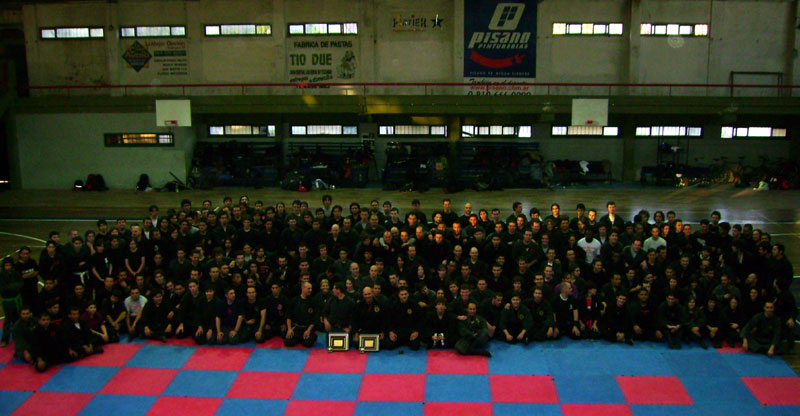
Argentina TaiKai
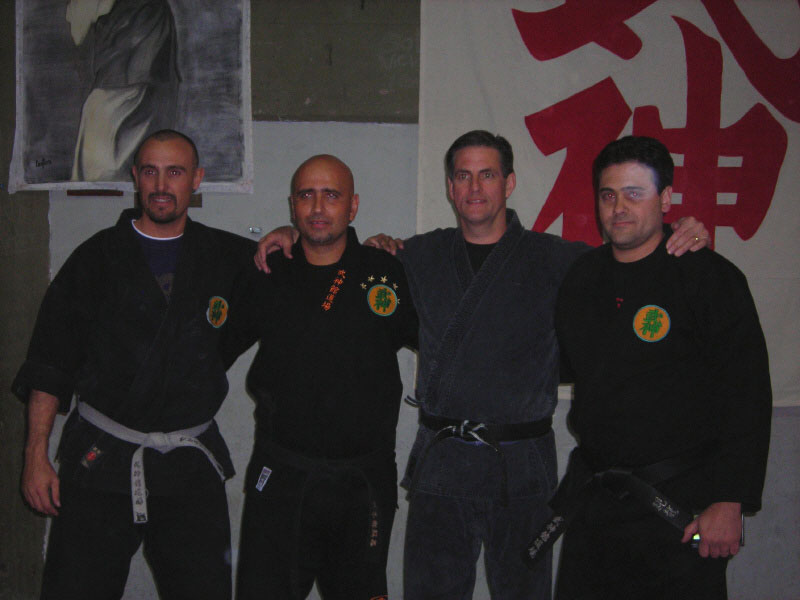
Christian, Pedro, Jack & Nestor
Evidently the press was very surprised by the huge turnout and friendly atmosphere. During an interview they asked my thoughts about the whole thing and I answered: "If we had put 260 diplomats from 11 countries in one room and asked them to find peace, they would certainly have fought. But we put 260 martial artists from 11 countries in a room and told them to fight and they made peace!" Thank you, Nestor, Christian, Pedro and all who made this TaiKai such an unforgettable experience!
This summer was also the tenth anniversary of the West Coast BuyūCamp in San Francisco under the Golden Gate Bridge on the Pacific Ocean, as well as, a fourth Buyū Camp East in New Jersey. Click the respective links to see some photos. Buyū Camps are a great way to connect with old friends and get that "continuing education" and inspiration that will help you "keep going" when you get back to your own, local training group. See you in San Fran and/or NJ again in 2008!
Something new this coming year will be the Buyū West Spring Training Seminar. People ask me for training recommendations all of the time. Well, if you live in, or can travel to, California, I endorse this seminar series. See the web page here and you will know why!
I was in Japan for the Daikomyosai Hatsumi Sensei's annual 3-day training event. I arrived in Japan feeling pretty good about myself. I had had a pretty darn good year, I thought, having trained consistently every day. I had trained Marines, law enforcement folks, martial artists all over the US and in Italy and don't forget that big TaiKai in Argentina. I landed at Narita on a Friday afternoon and was at the hombu dojo in Noda by 8pm that night for Sensei's training. But by about 8:15pm I realized the sad truth: I had a long way to go! Hatsumi Sensei's movement and control of the tactical space were just so much more advanced than mine. For about 5 seconds I was actually a bit discouraged. But then I realized that I was right where I needed to be—both geographically and mentally—in order to get where I wanted to go in my training.
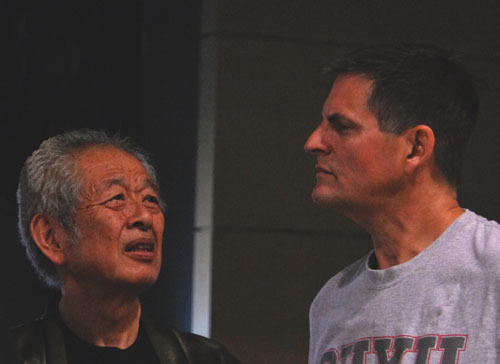
Photo by Sheila Haddad
With my feet back on the ground I felt a surge of confidence. Confidence in our teacher and mentor, and in his training methodology. And I thought, all I need to do is "keep going," and stay inspired by this great person who is so free and happy in mind, spirit and body.
Another seminar that has become an annual event is the "Life Values Workshop." This is a seminar where we practice our Budo in the context of Robert L. Humphrey's Life Values teachings. Many people have expressed interest in the STRIKE training that Humphrey devised to help Marines overcome the stress of real combat. If you want to experience it, we'll see you next July in New Jersey.
Please consult the WIN seminar page periodically for details of all of our workshops.
Some of the most rewarding work I did, again in 2007, was with the Marine Corps Martial Arts Program (MCMAP) in Quantico, Virginia. This fine program, led ably by my friend Joe Shusko (LtCol USMC ret.) covers the armed and unarmed martial arts techniques and combat conditioning that a Marine needs to walk the warrior path—both in combat and in daily life. There is a lot we "citizen warriors" can learn from the example set by the Marines in MCMAP. Notably, Joe and I agree that the most important aspect of the program is the "Ethical Warrior" training.
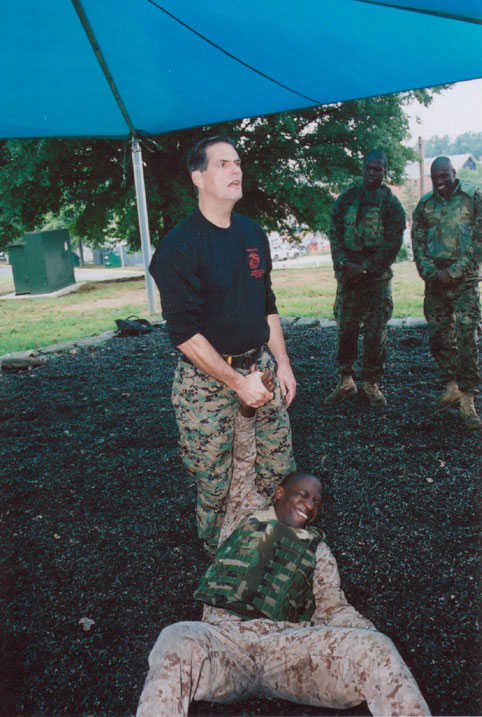
USMC photo courtesy of Homer Brett
If you are interested in the concept of the Ethical Warrior, an article I wrote on this subject was published in the Marine Corps Gazette this year; you can read it here. A shorter article on the same topic was published by a web magazine, here.
Last year we stressed physical training, clarification of the essence of warriorship, and defending others in the context of the battlefield martial arts of Kukishin Ryu. I came across the photo below this past year, and it sums up, for me at least, all three of these elements.
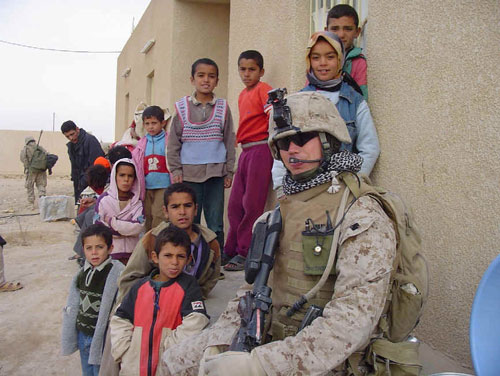
USMC Photo
This Marine is physically fit, well-trained in armed and unarmed combat, and is obviously a protector/defender of those children. His armor is not from centuries past, but from today. Yet, his calling is as old as mankind. Most of us are not Marines; that is not the point. The Bufu (martial wind) blows through the whole world and has done so over the millennia—it is not the province of just the Marines; it is not Japanese; it is not American. It is human.
I am fortunate to have two great teachers in my lifetime. One who said: "I am no country, I am UFO." The other said that all people share a Universal Life Value and a feeling of human equality that trump our cultural differences—if we allow them to. The point is that we are studying warriorship in the Bujinkan, and warriorship—the call to protect and defend life—is a human proclivity. We should not be confused or distracted by the cultures of the various martial arts. Instead, we must seek the essence—ride the Bufu.
It has been 27 years since I started training in this art. When I began I was an active duty Marine. One of the jobs of a Combat Engineer (besides blowing things up) is to do what is called "route reconnaissance." Forget the "recon ranger" stuff; for us, there was nothing "sexy" about it. We had to figure out if the route that the Marines were going to use in a movement or attack could withstand the traffic. (Would the roads hold up? Would the bridges collapse if we tried to drive a tank over them? This kind of thing.) Obviously, some of the route could be in enemy held territory, so we didn't want to get caught. I had first read about Ninja in a James Bond book called "You Only Live Twice." Being trained as a Ninja sounded like a cool thing and something I might even be able to use in my job.
At that time there was an American, Stephen Hayes, who had been to Japan and said that he had actually met and trained with a real Ninja. I contacted Stephen and he told me more about Hatsumi Sensei and invited me to Ohio to train. Within a year he had also introduced me to Hatsumi Sensei in person, when Sensei made his first visit to the USA. If it weren't for Stephen Hayes, I doubt that I would be writing this; and I doubt that you would be reading it.
Notably, we never used the term "Bujinkan" in those days; we were training in Togakure Ryu Ninjutsu or Ninpo. And we rarely talked about the differences between, or the specific characteristics of, the nine schools, or even the names of the techniques. Everything was the "same" and we just trained. You might say that the training was "harder" back then, but that was because we were younger and just naturally liked it that way. I remember that Bud Malmstrom and I were both Marines, so we had a natural bond and an inclination to train together that ended up causing a few busted lips and sore necks over the years.
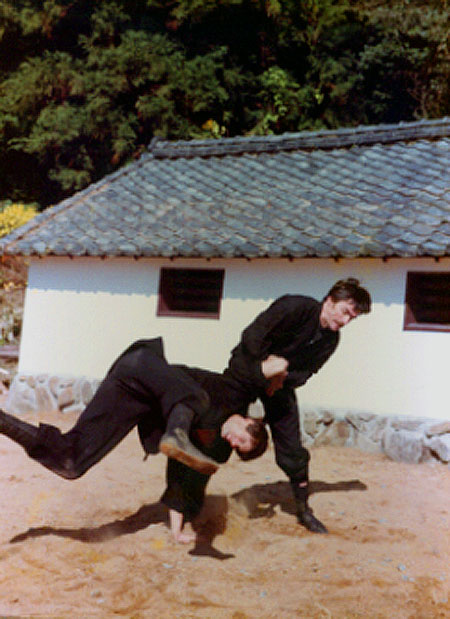
Jack & Bud circa 1983
Sadly we lost Bud's wife, Bonnie, this year. She was quite a lady and a very special person to many of us in the Bujinkan. A tribute web page is here.
I am thinking about all this, because now, 27 years later, the training theme for next year appears to be Togakure Ryu Ninjutsu. Interesting number, 27, there's a real Ninja number for you! Full circle, perhaps.
But I think, really, it is all the same and has been that way all these years. Call it what you want: Kukishin Ryu, Gyokko Ryu, Togakure Ryu, whatever—it is all Bujinkan. Bujinkan is greater than the sum of the parts, greater than all of the individual ryu-ha, no matter how carefully you practice the individual schools, or study the individual densho. When I step back, I see that the 9 arts may not even have survived if it weren't for Hatsumi Sensei's genius in creating the Bujinkan. In the grand scheme, few people really cared about the individual arts—until Hatsumi Sensei brought them back to life.
There is also some discussion these days about "hard vs. soft" training. But the thing to do, in my opinion, is to train according to your age and ability. When you are 25, train hard. When you are 50, you have to train differently—like Hatsumi was training when I met him. When you are 77, well, look at how Sensei trains now. If you train like an old man when you are young, it is not enough. If you train like a young man when you are old, you look violent and silly; and you will almost certainly become injured. The concept is not so difficult, really, just common sense; and certainly all of the arguments about it are unnecessary. The idea is to "keep going," train all of your life in a natural, effective and sustainable way. Most real combat has weapons, so don't focus too much on being only a "technician," or on being "strong" or "fast." Learn the taijutsu "tactical movement," and study how to use weapons effectively to leverage your taijutsu and escape—or do what is necessary to protect life. This is what I think Hatsumi Sensei has been saying consistently since I first met him.
And one other thing has been a constant: Sensei's training regimen. He always trained, watched his diet if his health was bad, and walked everyday. Sensei said: "The first step in Ninpo training is that of physical endurance." Please remember this point. Twenty five years ago I walked with Hatsumi Sensei (and 2 or 3 dogs) on many a night for 1-3 hours—after the training! And I am not the only one; he wore out many of us with these late night/early morning Ninja walks.
Another thing that Sensei has been talking about recently is the power of Buyū. As you know, Buyū means "martial arts friends," or perhaps, "comrades in arms." In order to keep going I encourage you to find compatibly-minded people who like training the way that you do and train together, inspire each other to keep going. The "community" of the Bujinkan is something that Sensei says is important. It is common sense that people who share a certain perspective on budo will want to train with each other. It is also natural that people with different ideas will want to train in a different way. Just remember one thing: Respect each other. Mutual respect, I think, will make the Bujinkan a natural community. Respect people who are different from you, just as you respect the people who train with you. From the day I met Hatsumi Sensei he always treated me with respect as a Buyū. Although he was obviously my senior in the martial arts, he never treated me as a "student;" he never treated me as somehow beneath him. In 2003 Sensei said that UFO can also mean "Unusual Friends OK!" Please think about this.
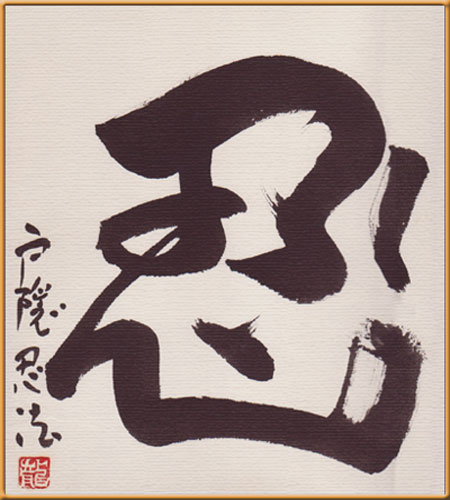
As I have said, next year is the year of Togakure Ryu. The calligraphy above, Nin - Togakure Ninpo, was painted for me by Hatsumi Sensei in the early 80's. So, in a way, we are back where we started—at least I feel like I am back where I started. In another way, however, we are entering a new era: where the Bujinkan, not as an organization, but as a concept and a community of mutual respect, can have a broader positive impact on the world than any one martial culture—or human culture.
Professor Humphrey once told me that it would take martial artists to save the world from another "Dark Age." I thought that he was just humoring me because I had such a strong interest in martial arts. Now I am not so sure he wasn't right (as usual).
But don't worry about saving the world; it's not really about doing something so much as it is about being something. The secret of being that "uncommon common" person who has the benevolent heart of the warrior is in the training. It is useless for me to try to write about it any more than this. So train!
In 2008 we look forward to the possibility of gaining a deeper insight into the way of the Ninja through training. So I recommend that you walk often—Ninja walk! Follow Sensei's example in terms of a fitness and a health regimen that is natural for you, and make it part of your lifestyle. But, most of all, respect yourself and your fellow Buyū. So, those are the themes for our Buyū training group for next year: train consistently, show respect.
Keep going in 2008, my Buyū. Thank you for all of the great training!
Jack Hoban
© 2021 Living Values. All Rights Reserved.

Warrior Painting By Gregory Manchess