
New Year's Message
January 1, 2010
Dear Friends:
Happy New Year!
As 2009 changes to 2010 I want to thank all of you for a wonderful year of training and personal exchanges on martial arts, values, and life. Domo Arigato!
2009 was another busy year. In terms of Bujinkan training, our Buyū (Warrior Friends) group enjoyed a twelfth Buyū Camp West in San Francisco under the Golden Gate Bridge on the Pacific Ocean, as well as, a sixth Buyū Camp East in New Jersey. Buyū Camps are a great way to connect with old friends, get valuable "continuing education," and stay inspired to "keep going" when you get back to your own training group. Click the respective Camp links for info on these yearly training opportunities; and check out our new Facebook page to see pictures and comments.
We had training seminars in NJ, California, Chicago, Michigan, Florida, Germany and the UK. It was great to hook up with my friends Steffen Fröhlich and Peter King - both lifelong Buyū. Also had fun in Michigan with Craig Gray and his MMA professionals. We did another seminar in honor of my Marine Corps mentor, Robert L. Humphrey in NJ this past summer. We covered Humphrey's Life Value Theory, warrior ethics, taijutsu, and the challenging and fun STRIKE training.
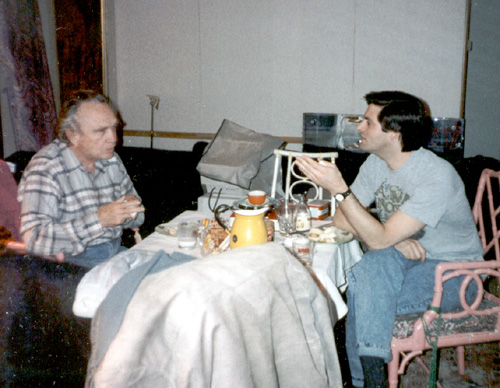
Bob Humphrey & Jack Hoban working on Humphrey's book "Values For A New Millennium."
If you are interested in Bob Humphrey's Life Values teachings, we'll see you at the "Ethical Warrior" seminar again next July in New Jersey. And please consult the WIN seminar page periodically for details of all of our Bujinkan workshops.
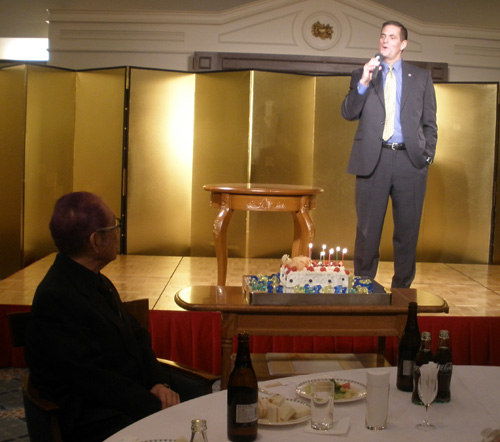
Singing "Happy Birthday" to Hatsumi Sensei at the Daikomyosai Party.
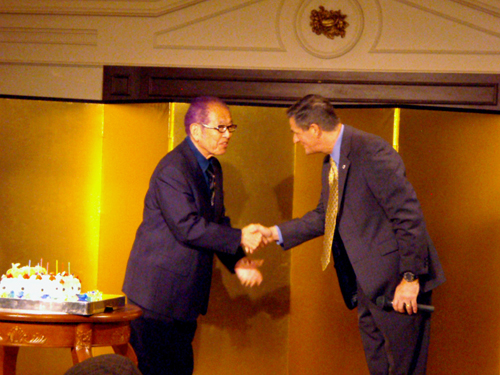
Wishing Sensei a Happy Birthday 2009
This past year I was again privileged to work with the Marine Corps Martial Arts Program ( MCMAP) in Quantico, Virginia. This fine program, led ably by my friend Joe Shusko (LtCol USMC ret.) and MSgt Tony Polzin covers the armed and unarmed martial arts techniques and combat conditioning that a Marine needs to walk the warrior path both in combat and in daily life.
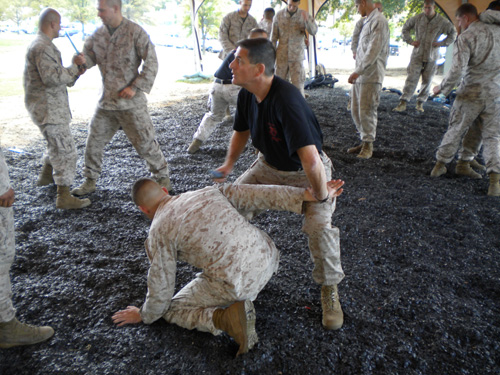
Training - USMC photo courtesy of Homer Brett
These young Marines - many veterans of both Iraq and Afghanistan - are physically fit and mentally tough, yet respectful and ethical. The methodology we use is simple but vitally important: train a lot, talk a bit, train a lot, talk a bit. The Marines relish the physical training, and then are open to hear how to use their training and ethics to maintain a professional "combat mindset" under the adversity of war. In martial arts training, it is often easy to focus on the physical part while giving mere lip service to the mental and character elements. But all three parts must go together.
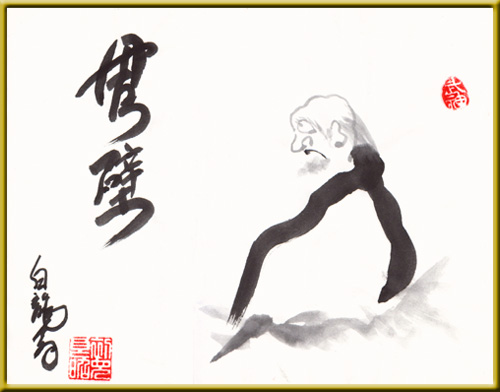
"Kanpeki"
The kanji, at first glance, looks simply like the word "kanpeki," which means "perfect." However, Hatsumi Sensei's artwork can always be interpreted in several ways. Looking at the painting, we see the founder of Zen ("Daruma" in Japanese pronunciation). It is said that he did "Shugyou" by sitting facing a wall for 9 years until his legs became useless and fell off. You may have seen the red, round Buddha-like dolls in Japanese shops and households.
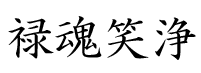
Rokkon Shoujou
Which brings us to 2010. It has been announced that the theme for 2010 is "Rokkon Shoujou" (六根清浄). This may refer to the Buddhist concept of "Rokkon Shoujou" (六根清浄) which originally means that we should not overindulge using our 6 senses (sight, hearing, smell, taste, touch and consciousness), but rather, purify ourselves from desire, perhaps by going into the mountains alone. As we see, Sensei has changed the kanji (as usual) so the meaning is...who knows what? "Receive happiness from heaven by cleansing one's spirit with laughter?" Again, only Sensei knows for sure. I guess we'll find out - if we keep going.
The best way to keep up with Hatsumi Sensei is doing is to go to Japan, of course. But, between trips, I highly recommend Doug Wilson's blog. There is also a lot of good information on Joji Ohashi's site here.
As I have said many times, I began my training with Hatsumi Sensei when I was 25 and he was 50. During my recent visit to Japan it became clear to me within the first 10 minutes of training, once again, that Hatsumi Sensei is still 25 years ahead. The "theme - no theme" of 2009 in Japan evolved into ability, heart, capacity with a heavy emphasis on "connectedness." It made me think about how we must strive to use our abilities to stay connected to the heart of the Bujinkan teachings according to our own personal capacities.
What are Ethical Warriors? In a speech I gave at the Marine Corps Museum in Quantico, Virginia on December 18, 2009, I used these words: "The Ethical Warrior is a protector of life. The Ethical Warrior is not just a fighter, although we do fight of course. Not merely a killer, although we may be called upon to kill. The Ethical Warrior is first and foremost a protector a protector of our country...of our friends and allies, protectors of the innocent and sometimes not so innocent....[And] yes, sometimes we are also protectors of our enemies. An oxymoronic-sounding concept for sure, but that is why it is so anti-intuitive and a secret. Protectors of self and others. Which others? All others. If we can. That's what we do."
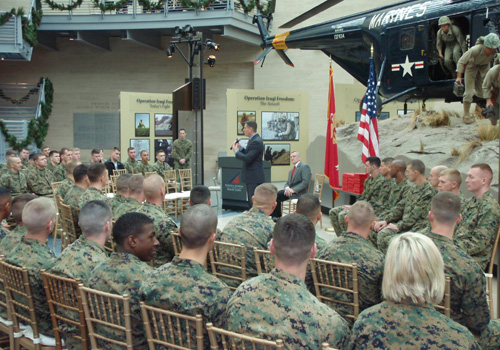
USMC photo courtesy of Homer Brett
Killing only to protect life. Cleanse your mind of everything else. That is the morality of the warrior. You cannot take a predatory approach, because you are not a predator. You are a protector. You have a conscience. Turn it on - don't try to turn it off.
People may say: "That's soft; warriors have to deal with hard people. You will make the students weak or hesitant or too nice with that approach." Wrong. That is like saying that the protective nature of a Father for his son, or a Mother for her children, or a Marine for his men, makes them weak. In fact, extending our protective inclinations wider and wider helps us become stronger, not weaker. Safer, not more vulnerable.
Martial arts is not just for protecting the body anyway; in war you have little control over what happens to your body. In fact, the greatest warriors are often killed, because they have to lead and do the difficult things most cannot do.
But what if you don't die? What if you live? That is the hardest part - to live after doing what had to be done. So, true warrior training has at the core, most importantly, methods to protect the mind and spirit in case you live. The physical techniques and tactics may protect the body; but the ethics protect the soul.
It's a good life being a protector, a better life. But it is still dangerous. That is why we will work hard to hone our martial arts skills. All of them.
That is our mission for 2010. To explore the life preserving wisdom of our art within the techniques themselves. Gambattemashou!
Jack Hoban
© 2021 Living Values. All Rights Reserved.

Warrior Painting By Gregory Manchess