
|
New Year's
Message
January 1, 2011
Dear Friends:
Happy New Year!
I hope your 2011
is full of joy,
peace and
happiness.
And great
training!
2010 was a very
full year with
many wonderful
experiences,
some challenges,
and a few sad
moments.
Circle of life.
One of the most
significant
things to happen
this year was
the early
passing of Buyῡ
Dojo co-founder
Mark Hodel.
Mark and I were
friends for
nearly thirty
years and we had
many adventures
together – both
in and out of
the Bujinkan.
Mark was
co-founder of
the Warrior
Information
Network and
co-sponsored 6
Tai Kai’s,
including the
"Last TaiKai" in
2003. He
also published
Hatsumi Sensei's
Tetsuzan and
Sanmyaku
newsletters.
Mark trained in
Japan numerous
times and
organized a
number of trips
that facilitated
many people's
first training
experience in
Japan. Countless
practitioners
around the world
were introduced
to the Bujinkan
through Mark's
efforts – directly or
indirectly.
If you are
reading this you
are probably one
of them.
His impact on
the growth of
the Bujinkan in
the world cannot
be overstated.
Mark was also
the co-publisher
of Robert
L. Humphrey's
book "Values
For A New
Millennium."
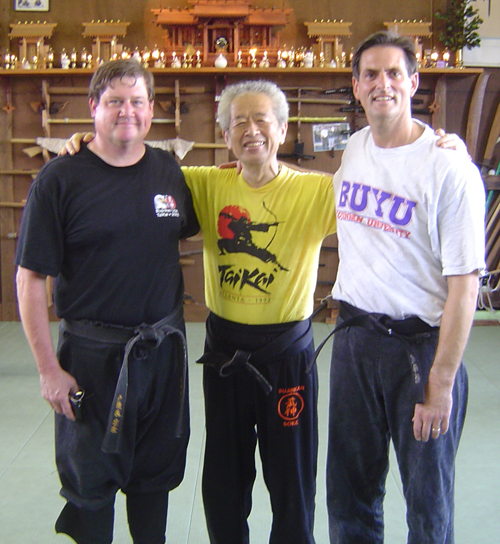
Mark Hodel,
Masaaki
Hatsumi,
Jack Hoban
Plus, he was a
great guy.
Mark was a real
ninja, always in
the background,
always promoting
others but not
himself,
coaching,
mentoring, being
a friend and
buyῡ.
There is a Mark
Hodel Memorial
Page here.
If you have not
done so already,
please consider
leaving a
remembrance on
the comment
wall.
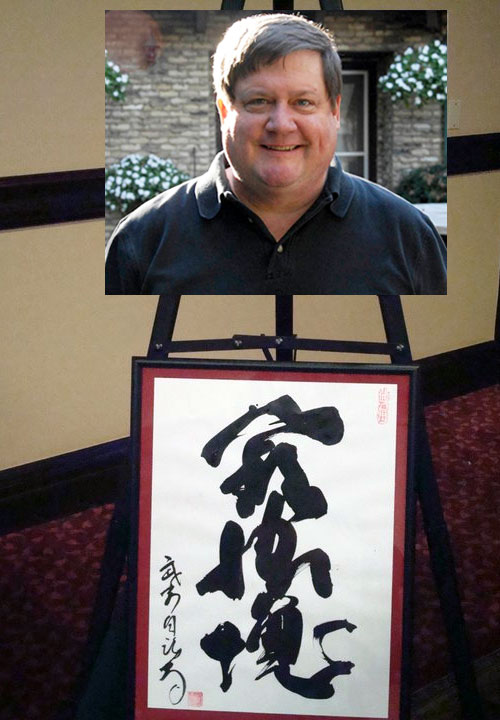
Mark Hodel
1953-2010
(Painting By
Masaaki
Hatsumi)
Good bye,
Mark. You will
be sorely
missed, but
never forgotten.

2010 was,
perhaps, my
busiest year
ever for
training and
traveling. Our
Buyῡ (Warrior
Friends) group
enjoyed a
thirteenth Buyῡ Camp
West in San
Francisco under
the Golden Gate
Bridge on the
Pacific Ocean,
as well as, a
seventh Buyῡ
Camp East in
New Jersey.
Buyῡ Camps are a
great way to
connect with old
friends, get
valuable
"continuing
education," and
stay inspired to
"keep going"
when you get
back to your own
training group.
Click the
respective Camp
links for info
on these yearly
training
opportunities – and check out
the Photos tab
on our Bujinkan
Buyῡ
Facebook page to
see pictures and
comments.


We had training
seminars in NJ
and California.
I visited Don
Smith, Paul
Fisher, Ed
Figueroa and the
guys and gals in
Florida twice.
I was in Chicago
with Jim
Morganelli and
his group, twice
also. And I went
to Michigan to
train with Craig
Gray.
2010 was also a
great year for
meeting up with
old friends. I
did two seminars
with Stephen K.
Hayes that
explored the
ethics and
leadership
skills of the
warrior.
Stephen and I
are planning
more events in
2011 – so stay
tuned!

Stephen &
Jack 2010
Bud Malmstrom
and I also did a
very interesting
law
enforcement-oriented
seminar in
Atlanta.
Bud will be here
in NJ in April
2011 – you are
welcome to join
us! Info
is here.

Bud & Jack -
2010
We did another
seminar in honor
of my Marine
Corps mentor, Robert
L. Humphrey in
NJ this past
summer. We
covered
Humphrey's Life
Value Theory,
warrior ethics,
taijutsu, and
the challenging
and fun STRIKE
training.
If you are
interested in
Bob Humphrey's Life
Values teachings,
we'll see you at
the "Ethical
Warrior" seminar
again next July
in New Jersey.

And then there
were the
International
seminars.
I went to
Germany twice
with Steffen
Fröhlich –
including the
BuyuKai; and he
and I joined our
new friend
"Pucci"
(Giuseppe Costa)
in sunny
Sicily.

Sicily is a
wonderful place
with sincere
martial artists,
warm-hearted
people, hot sun,
great food, and
excellent wine.
I made many new
friends there.
Grazie mille!
Actually,
Steffen and I
were together
five times in
2010 – all over
the world.
Thank you
Steffen for your
friendship and
all the great
training!

Jack &
Steffen -
Taoromina,
Sicily 2010
Steve Kovalcik
and I did a nice
seminar in
London – and had
a few pints,
too.
Thanks to Murray
Taylor for
joining us!
I did a TaiKai
in Buenos Aires,
Argentina
sponsored by my
friends "Don"
Juan Manuel and
Marcello
Ferraro.
More great
martial artists,
wonderful food
and wine – and
new amigos.
I can't thank
you all enough.
Muchas gracias!


Nestor, Don
Juan, Jack,
Marcelo,
Christian,
Maxie -
Buenos
Aires,
Argentina
2010
I had an
extremely
touching moment
in Buenos Aires.
I had just
finished talking
about the Warrior
Creed when a
nicely dressed
middle-aged
couple
approached me.
They were
crying.
They told me
that they had
come to pick up
their son from
the seminar and
were going to
take him out to
dinner and tell
him that they,
his parents,
were going to
divorce.
But when they
heard the story
of the Warrior
Creed,
especially the
part where
"everyone should
be happier when
you go home,"
they decided to
stay married.
Now we were all
crying!
I'll never
forget that
family in
Argentina who
really took Dr.
Humphrey's words
to heart.
God bless them!
Next year will
probably bring
more travels.
For sure I am
going to
Switzerland, as
our friend Phil
Bradshaw has
opened his new
Buyῡ Dojo in
Zurich.
Check it out here!
Please consult
the WIN
seminar page periodically
for details of
all of our
workshops.

As usual, many
of us were in
Japan for the
Daikomyosai –
Hatsumi Sensei's
annual 3-day
training event.
Hatsumi Sensei
was as vibrant
as ever – even
though the
training was
very crowded and
fresh air was at
a premium.
He trained all
three days, and,
as usual, set
the bar high for
all of us as we
continue on our
martial
journeys.

Photo by
Sheila
Haddad
And not just
anyone can pull
off that
hairstyle!
As always, I was
called to lead
the group in
singing "Happy
Birthday," as
the Daikomyosai
commemorates
Sensei's
birthday. We
followed it up
with a rousing
rendition of
"You Are My
Sunshine."

"You Are My
Sunshine"
Every year it
seems that our
Buyῡ group grows
a little more.
We really have a
lot of fun
training and
enjoying each
others' company.

Buyῡ in
Japan 2010

This past year I
was again
privileged to
work with the
Marine Corps
Martial Arts
Program (MCMAP)
in Quantico,
Virginia.
This fine
program is led
ably by LtCol
Pat Beckett, my
good friend Joe
Shusko (LtCol
USMC ret.), and
MSgt Tony
Polzin. It
covers armed and
unarmed martial
arts techniques,
combat
conditioning,
mental training,
and character
development.
I can't say
enough about
these young
Marines who I am
privileged to
train.
They are
physically and
mentally tough,
yet respectful
and ethical.
Many are
veterans of both
Iraq and
Afghanistan.
The methodology
we use is simple
but vitally
important: train
a lot, talk a
bit, train a
lot, talk a bit.
The Marines
relish the
physical
training, and
then are open to
hear how to use
their training
and ethics to
maintain their
ethics and a
"combat mindset"
under the
adversity of
war. In
martial arts
training, it is
often easy to
focus on the
physical part
while giving
mere lip service
to the mental
and character
elements.
But all three
parts must go
together.

"Training" -
USMC photo
courtesy of
Homer Brett
2010

"Talking" -
USMC photo
courtesy of
Homer Brett
2010

"Marine
Ethical
Warriors" -
USMC photo
courtesy of
Homer Brett
2010

It seems that
this concept of
an Ethical
Warrior –
protector of
life – is
starting to
resonate with
people. I
had an article
published in the
Marine Corps
Gazette in 2010
that was well
received.
You can read it here.
The terms
"values,"
"morals," and
"ethics" are
used imprecisely
in our society,
in my opinion.
I think that it
is very
important to be
able to
understand the
distinctions –
particularly if
you are a
warrior who
might be
involved in
violent or
deadly
situations.
In order to
facilitate our
work in the
Marines and also
RGI (see below),
I created this
Humphrey-inspired
primer on
Values, Morals
and Ethics, and
offer it here:
|
Values, Morals,
and Ethics
Values.
According to the
dictionary,
values are
“things that
have an
intrinsic worth
in usefulness or
importance to
the possessor,”
or “principles,
standards, or
qualities
considered
worthwhile or
desirable.”
However, it is
important to
note that,
although we may
tend to think of
a value as
something good,
virtually all
values are
morally relative
– neutral,
really – until
they are
qualified by
asking, “How is
it good?” or
“Good to whom?”
The “good” can
sometimes be
just a matter of
opinion or
taste, or driven
by culture,
religion, habit,
circumstance, or
environment,
etc.
Again, almost
all values are
relative. The
exception, of
course, is the
life value. Life
is a universal
value. We might
take this point
for granted, but
we all have the
life value, or
we would not be
alive. Life is
also a dual
value – self and
others.
Morals.
Moral values are
relative values
that protect
life and are
respectful of
the dual life
value of self
and others. The
great moral
values, such as
truth, freedom,
charity, etc.,
have one thing
in common. When
they are
functioning
correctly, they
are life
protecting or
life enhancing
for all. But
they are still
relative values.
Our relative
moral values
must be
constantly
examined to make
sure that they
are always
performing their
life-protecting
mission. Even
the Marine Corps
core values of
"honor, courage
and commitment"
require
examination in
this context.
Courage can
become foolish
martyrdom,
commitment can
become
irrational
fanaticism,
honor can become
self-righteousness,
conceit, and
disrespect for
others. Our
enemies have
their own
standard of
honor, they have
courage, and
they are surely
committed. What
sets us apart?
Respect for the
universal life
value sets us
apart from our
enemies.
Ethics. A person
who knows the
difference
between right
and wrong and
chooses right is
moral. A person
whose morality
is reflected in
his willingness
to do the right
thing – even if
it is hard or
dangerous – is
ethical.
Ethics are moral
values in
action. We
have to be
ethical because
morality
protects life
and is
respectful of
others – all
others. It is a
lifestyle that
is consistent
with mankind’s
universal values
as articulated
by the American
Founding Fathers
– human equality
and the
inalienable
right to life.
As warriors it
is our duty to
be protectors
and defenders of
the life value
and to perform
the unique and
difficult
mission of
taking the lives
of those acting
immorally
(against life)
when necessary
to protect the
lives of
innocent others.
When you must
kill protecting
life it is still
hard, but it is
moral. Those who
kill those not
observant of
their narrow
relative
religious,
ethnic or
criminal values
– in other
words, kill over
relative values
– are immoral. A
dedication to
protecting the
life value of
self and others
– all others –
makes the
Ethical Warrior
different and
moral.
|
If all of that
is a little too
philosophical, I
hear you!
So we also
created this
vignette to
explain the
terms in a more
down-to-earth
way. We
call it:
|
"The Bully"
You are in the
schoolyard. You
see a bully. His
thinks he is
“top dog.” That
is fine. That
perception is a
relative value.
But when his
relative value
supersedes the
life value of
another kid – in
other words,
when the bully
picks on and/or
punches the
other kid – this
is wrong!
Here is the
rule: relative
values, no
matter how
“great,” cannot
supersede the
life value.
You see the
bully picking on
the other kid.
You feel – in
your guts – that
this is wrong.
Congratulations,
you are moral.
(By the way,
most people are
moral – they
know the
difference
between right
and wrong).
Now…you see the
bully picking on
the other kid.
You overcome the
“freeze,” you
overcome the
embarrassment,
and you go tell
a teacher.
Congratulations!
You are ethical.
(Ethics are
moral values in
action).
Now…you see the
bully picking on
the other kid.
You overcome the
“freeze,” you
overcome the
fear, and you go
to the aid of
the kid being
bullied. You put
yourself at
risk.
Congratulations!
You have the
makings of an
Ethical Warrior.
|

In 2010 I formed
a company made
up of military
and law
enforcement
professionals
called
Resolution Group
International (www.rgi.co).
RGI continues
the work I have
done with Robert
L. Humphrey and
the Marines in
the areas of
ethics, conflict
communication
and physical
protection
skills. We had
our first RGI
Conflict
Resolution
Course last
September and it
went very well.

First RGI
Conflict
Resolution
Course - 2010
If you are
interested in
exploring the
Ethical Warrior
concept further,
or applying your
training to law
enforcement or
military
scenarios, or
just want to
work with these
interesting men
in a hands-on
setting, check
out RGI
Events.
Bruce Gourlie
and I have also
started to write
a series of
articles
entitled "The
Ethical Warrior"
for law
enforcement
audiences.
You can read
them at PoliceOne.com.
Links to the
articles are
also
here.

Another fun
thing I
did again this
year was to
"train" a cool
new literary
hero, Nick
Heller, from the
Joseph Finder novels.
It started with
"Vanished;" and
I was asked to
contribute again
in his new book
"Buried Secrets"
(comes out June
21, 2010). These
are great
thrillers – if
you get a chance
to pick one up,
check out the
fight scenes.

Which brings us
to 2011.
This year
Hatsumi Sensei
has selected the
theme of "Kihon
Happo."
Hey, I love it!
But not so fast.
He is using very
unusual kanji in
this kihon
happo: 季翻初崩.
季 ("ki") can
mean "season" or
"end," 翻 ("hon")
can mean "turn
around" or
"reverse," 初
("ha") can mean
"first time" or
"basic" (it is
also the first
kanji of
Hatsumi), and 崩
("pou") can mean
"collapse" or
"break down."
There is no way
to precisely
interpret
Sensei's
meaning.
But we can be
patient
and enjoy
learning what
Sensei is
teaching as the
training unfolds
over the next
year. And of
course, practice
the kihon happo.
As readers of
this yearly
message know, in
an attempt to
maintain the
"thread" that
reaches to
Hatsumi Sensei
across the 25
year differences
in our training
and life
experiences, I
create a Buyῡ
theme each year
to try to help
"connect the
dots."
Last year we
looked at the
san shin and
kihon happo in
terms of
"techniques,
tactics and
ethics."
We discovered
that the ethic
of protecting
self and others
– all others –
was built right
into the
techniques.
But we had to do
them well,
because being
ethical and
compassionate
could also be
more dangerous.

Seen tacked to
the wall at the
Marine Corps
Martial Arts
Center of
Excellence -
2010
This year I want
to explore what
happens when the
ethics and
physical
training come
together.
Can it help us
function more
effectively in a
conflict?
That coolness
under pressure,
the ability to
overcome the
"freeze" and act
when thrust into
a sudden violent
situation is
sometimes called
the "combat
mindset."
One way of
describing the
combat mindset
is the ability
to maintain a
"professional"
frame of mind
despite the
physical and
emotional
stresses of war.
Professionals
are able to
focus on
accomplishment
of the mission
without being
overwhelmed by
the natural
emotional
reactions to
stress and
combat – such as
fear, anger,
desire for
revenge, and
other
counterproductive
distractions. I
believe that
professionalism
under fire can
be developed
through a
combination of
conscious
ethical
discipline and
consistent
physical
training.
Warrior ethics
(moral protector
values in
action) are the
“true north”
that guide us
through the
debilitating
physiological
challenges,
stress and
emotions that
can assail us
during violent
confrontations –
e.g. the “fog of
war.” The
training kicks
in and we do
what needs to be
done. In short,
a combat mindset
is a
manifestation of
the combined
ethical,
tactical and
physical
disciplines.

The Combat
Mindset helps us
to “do the right
thing” under
extreme
emotional,
psychological
and physical
adversity or
stress. This
includes the
ability override
the emotions
(including the
fight, freeze or
flight
mechanism) and
act
“professionally”
and in
accordance with
our moral and
physical
training. You
may notice that
there are
several
important
concepts above
that are in
quotes – that is
because they are
difficult to
define
adequately.
Perhaps the best
we can do is
make a
comparison. When
subjected to
stress and
danger people
tend to behave
in basically one
of two ways. One
is called
“affective,”
that is,
emotionally.
Emotional
behavior is
usually
ineffective in
times of great
danger when
critical
decisions need
to be made and
acted upon. The
other behavior
is called
“effective”
behavior, and
that is the
behavior of a
predator. The
predator is cold
and rational –
like an animal
intent on
killing for
food.
Our training, on
the other hand,
is designed to
create a third
behavior option:
that of the
protector of
life. Whose
life? Self and
others. Which
other? All
others, if
possible.
Killing only to
protect life.
This seemingly
oxymoronic
statement –
killing only to
protect life –
is the behavior
of the Ethical
Warrior. It is
predator-like,
in can be cold
and
professional.
But the
objective is to
protect, not
kill.

So that is the
theme of our
2011 Buyῡ
training: "Kihon
Happo and the
Combat Mindset."
How does a
combination of
moral and
physical
training help us
stay ethical
under stress and
still coldly
professional –
able to overcome
the "freeze" and
do what needs to
be done to
protect and
defend life?
Gambattemashou!
And don't forget
to enjoy
yourself!
Jack Hoban
|